
Many crystal lovers have had this experience: you walk into a crystal shop with no intention of buying anything, yet your eyes are inexplicably drawn to one particular stone. You pick it up. It feels strangely comfortable in your hand. You put it back, but you hesitate. In the end, you take it home.
Some call it “fate.” Others call it “chemistry.” And some say — the crystal was “calling” to you.
Is this just imagination, or is there actually some mechanism at work?

What Is “Resonance”?
Let’s start with a concept from physics: resonance.
Imagine walking into a concert hall where a musician is tuning a cello. When they pluck one string, another cello nearby — untouched — begins to vibrate softly. That is resonance: when two objects share the same frequency, the vibration of one causes the other to move.
Crystals work similarly. Each crystal has a stable molecular structure and a vibrational frequency, though these frequencies are usually too subtle to measure with ordinary instruments. Human cells, tissues, and organs also have their own vibrational frequencies. Theoretically, when a person’s frequency aligns closely with a crystal’s, there may be a sense of “being in sync.”
Of course, applying this physical phenomenon directly to the human-crystal experience requires caution. There is currently no direct scientific evidence that “resonance” between a person and a crystal produces measurable biological effects. Still, as a framework for understanding why some crystals feel particularly attractive, it offers a plausible line of thought.

Visual Attraction
Beyond the physical possibilities, there is a simpler and more direct explanation: the eye’s choice.
The color, luster, and transparency of crystals are naturally visually appealing. Over the course of human evolution, we have developed innate preferences for certain visual characteristics — smooth, lustrous objects tend to evoke positive emotional responses. This instinctive reaction happens before conscious awareness, making it feel as though we were “drawn involuntarily.”
The purple of amethyst, the deep blue of lapis lazuli, the shimmer of labradorite — different people have different color preferences, shaped by personal experience, personality, and even current emotional state. Someone under a lot of stress may be drawn to calming blues and whites. Someone in need of courage may find red or orange crystals unusually striking. Color preference is often an indirect form of self-expression — more honest than words.
The Comfort of Touch
There is another factor often overlooked: how a crystal feels in your hand.
Temperature, weight, and surface texture all influence how we perceive a crystal. A smooth, palm-sized stone feels completely different from a rough, angular raw crystal. The former is comforting; the latter is alerting. These tactile preferences also operate beneath conscious awareness.
Many people naturally “test” a crystal by holding it — feeling its weight, running their fingers over its surface, sensing whether it fits comfortably in the palm. This physical check is a way of knowing with the body. When a crystal’s touch is relaxing, the feeling of “this one is right for me” easily follows.
The Experience of Being “Called”
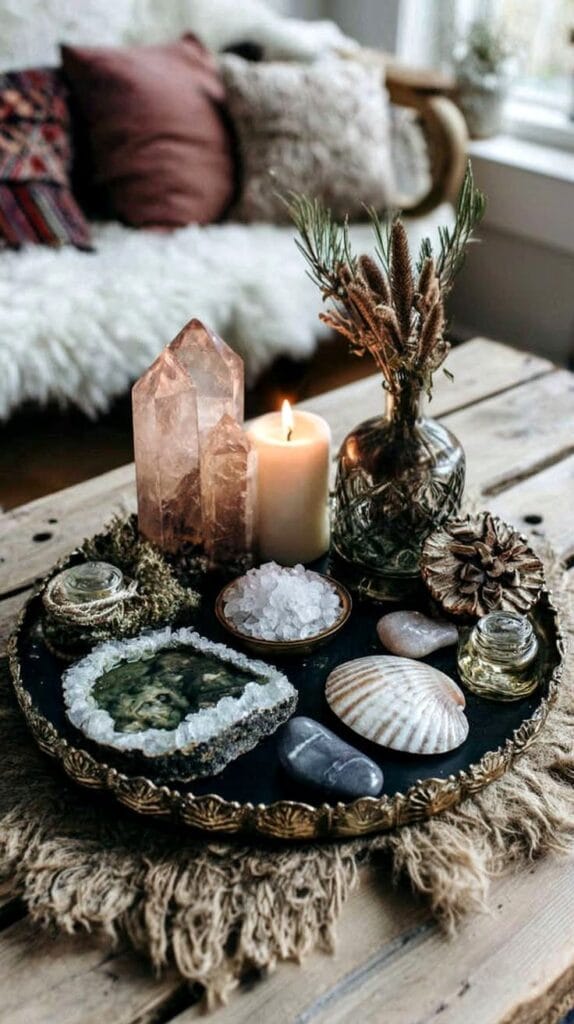
Let’s reconstruct the typical “being called” scene: you walk into a shop, and your gaze automatically lands on a particular crystal. You pick it up, and it feels more “right” than the others — more pleasing to the eye, more comfortable in the hand. You put it down, but you keep glancing back. Eventually, you decide to buy it, without being able to explain exactly why — just that it felt like you “should take it home.”
If you had to put words to this process, you might say, “It was calling me.” But looking at the process itself, “calling” is more of a metaphor — a way to describe an intuitive, non-verbal process of selection. The body and the subconscious often know the answer before the conscious mind does; the conscious mind simply needs a story to explain it. “It was calling me” is that story.
How to Tell the Difference Between Being “Called” and Just “Wanting to Buy”
Being “called” and making an impulsive purchase can look similar, but the motivations are different.
An impulsive purchase is usually driven by price, rarity, or what others have said. Your heart beats a little faster, but once you get it home, the feeling is often: “Why did I buy this?” In contrast, being “called” is quieter. You can’t quite explain it, but you just feel like “this one is mine.” There is no regret afterward — maybe even a quiet sense of joy.
A simple test: put the crystal down in the shop, walk around, and come back. If it still feels special when you return, it’s probably a genuine connection. If it feels ordinary upon second look, it may have just been a fleeting novelty.
The idea that “a crystal calls to you” does sound mystical. But if we translate it into simpler terms, it really means this: humans have a capacity for perception that goes beyond rational analysis. Sometimes, the body knows what is right for us before the mind does. Crystals just happen to be a medium through which this perception can become tangible.
The next time you encounter a crystal that seems to “call out” to you, feel free to take it home. Perhaps it does carry special energy. Or perhaps it simply matches your aesthetic taste at that moment. Either way — you chose it for a reason, even if that reason isn’t entirely clear to you yet.
Reference:
- Rasmussen, H. (2026). How crystals are born: Geological formation. In Crystals & crystal healing course ebook (pp. 22–26). The Magicka Academy.

