
If you love crystals, you may have had this experience: even among clear, transparent stones, some feel warm in your hand while others make you feel especially grounded. Is this just your imagination, or do crystals truly have “personalities”?
The answer is: a crystal’s personality has a great deal to do with its chemical recipe.

What Is a Crystal’s “Recipe”?
Think of a crystal as a cake. The flavor of a cake depends on its ingredients — flour, sugar, eggs. In the same way, the character of a crystal depends on the chemical elements that compose it.
For example, the most common elements in crystals are silicon and oxygen, which form the “basic dough” of quartz-family crystals. But what truly makes each crystal unique are the trace elements present in tiny amounts — they are like that pinch of cinnamon or grate of lemon zest that defines the soul of the whole cake.

Iron: Making Crystals “Grounded”
Let’s start with iron. This element is found in many crystals, such as hematite and pyrite. Iron has a special property: it is magnetic and can resonate with Earth’s magnetic field.
On an energetic level, iron-rich crystals are often considered excellent for “grounding.” What does that mean? When you feel scattered, anxious, unsteady, or “floating,” these crystals can help pull your energy back into your body, making you feel more present and stable. In short, iron acts like an emotional anchor within a crystal.
Silicon: Amplifying Energy
Now let’s look at silicon. Silicon is the main component of quartz-family crystals, such as clear quartz, amethyst, and rose quartz. Silicon has a unique ability: its crystal structure is highly regular and symmetrical, allowing it to conduct and amplify energy efficiently.
This is why quartz is widely used in modern technology — computer chips, quartz watches, and communication devices all contain it. On an energetic level, this property makes quartz crystals “energy amplifiers.” When you “tell” a clear quartz crystal an intention (such as “I want to be more confident”), it may turn up the volume on that intention — amplifying, focusing, and transmitting that energy outward.
Copper: Keeping Energy Flowing
Another important element is copper. Copper is famously a great conductor of electricity, found everywhere in wires and circuit boards. In the mineral world, copper-bearing crystals such as malachite and azurite inherit this same “good conductivity.”
From an energetic perspective, copper-bearing crystals are believed to promote the flow of energy and clear “stuck” places. If you feel creatively blocked, emotionally constricted, or simply “clogged up,” a copper-bearing crystal may help you. It acts like an energetic drain cleaner, getting things moving again.
Different Recipes, Different Personalities
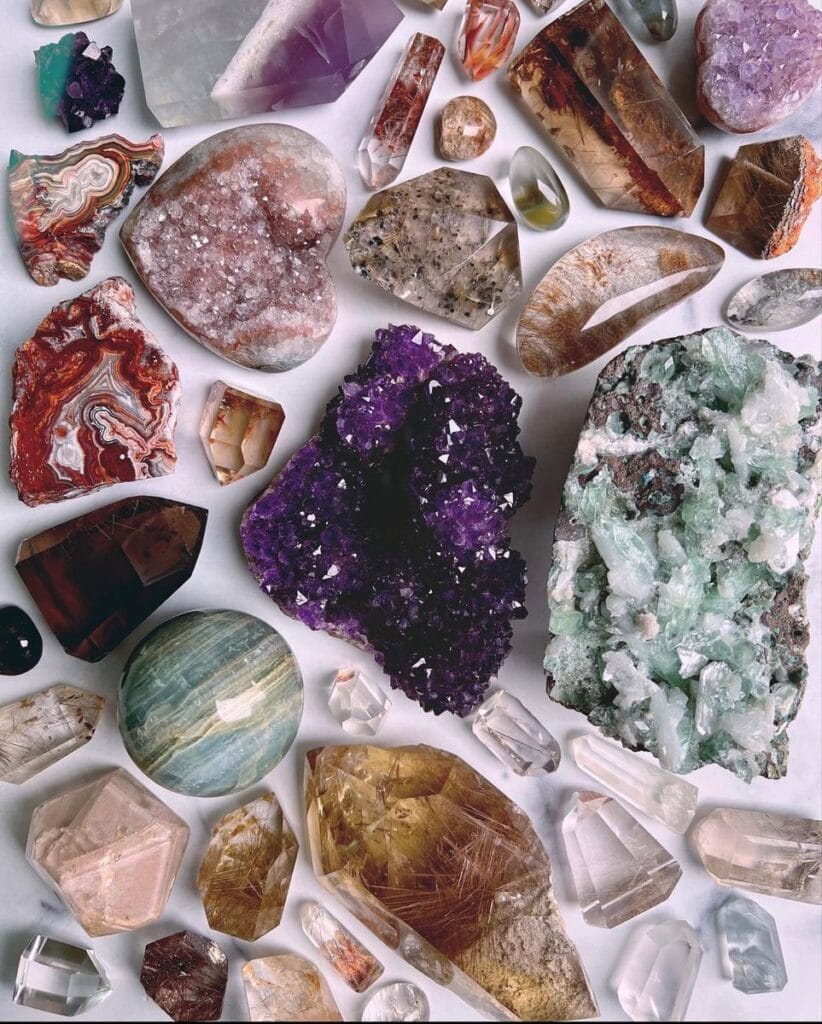
The same elements, combined in different ways and crystallized in different environments, produce vastly different crystals. For example, take quartz: pure silicon-oxygen is colorless clear quartz. Add trace amounts of iron and expose it to natural radiation, and you get amethyst. Add iron but distribute it differently, and you get smoky quartz.
Just like the same flour and water can become steamed bread or noodles — the basic recipe is the same, but the “method” differs, so the results are completely different.

Why Does the Recipe Matter?
Knowing a crystal’s chemical recipe isn’t about memorizing the periodic table. It gives you another way to choose crystals. If you feel you need stability and security, you might prefer iron-rich crystals. If you want to amplify a goal or intention, quartz-family crystals are a good choice. If you want smoother energy flow and more active creativity, copper-bearing crystals may suit you better.
The next time you pick up a crystal, consider: what’s in its recipe? Those invisible trace elements may be quietly influencing your energy field.
Of course, the energetic effects of crystals are currently based largely on traditional experience and theoretical interpretation — more scientific research is needed. But understanding their “origin story” at least gives you more confidence and less guesswork when choosing.
After all, a crystal whose background you know may feel a little different in your hand.
Reference
- Rasmussen, H. (2026). How crystals are born: Geological formation. In Crystals & crystal healing course ebook (pp. 22–26). The Magicka Academy.

