
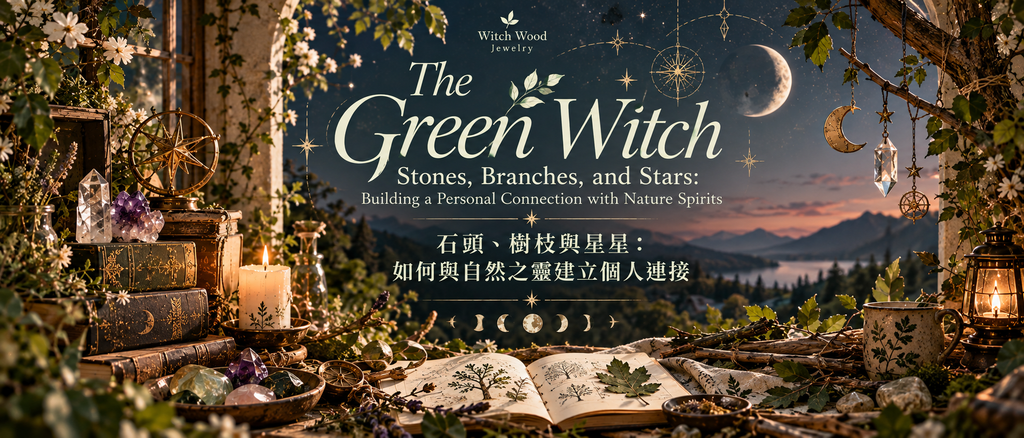
In everyday city life, contact with nature is often visual—seeing trees, seeing flowers, seeing the sky. But seeing and connecting are two different things. Seeing is one-way. Connecting is two-way: you send attention to nature, and nature responds in some way.
In the green witch tradition, there is a core practice: relearning how to “talk” with nature. This conversation is not necessarily verbal. More often, it happens through the senses, intuition, and subtle body reactions. Stones, branches, leaves, stars—these seemingly silent things carry information that can be sensed. The question is whether we are willing to stop and take the time to receive it.
This article gathers several basic nature connection exercises: how to sense the energy of a tree, how to cleanse and “program” a stone, how to read a tree’s character through its branches and leaves, and how to use the stars and moon phases to tune your own rhythm.
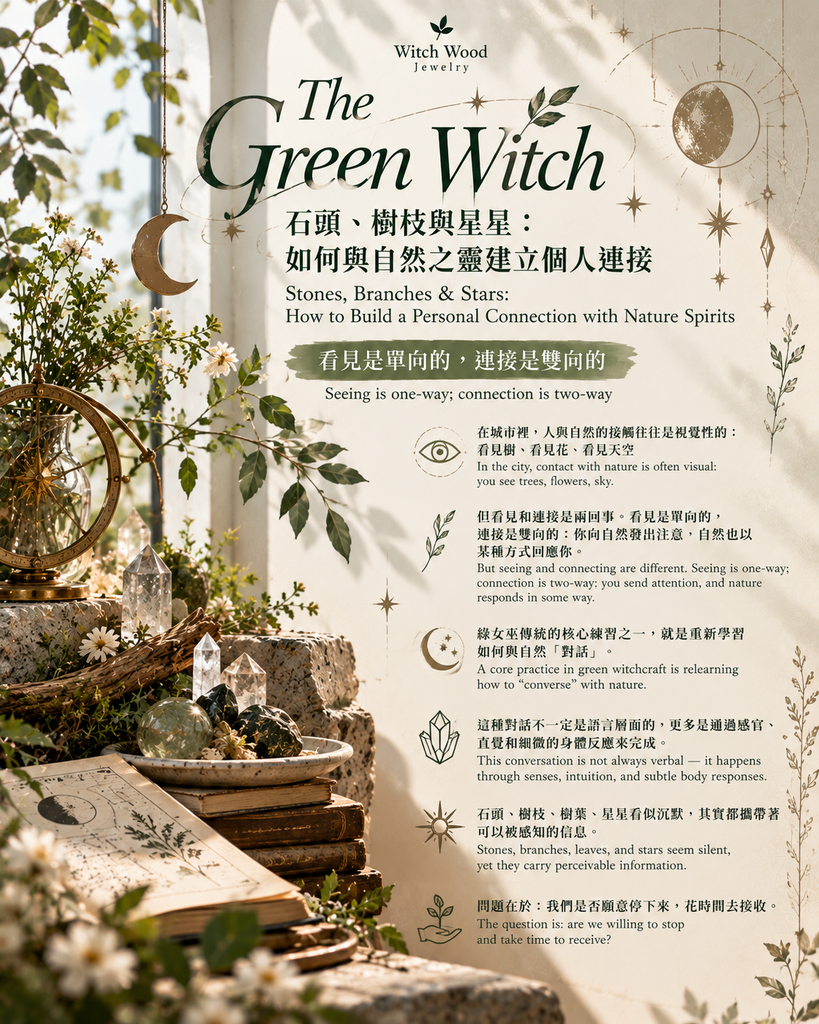
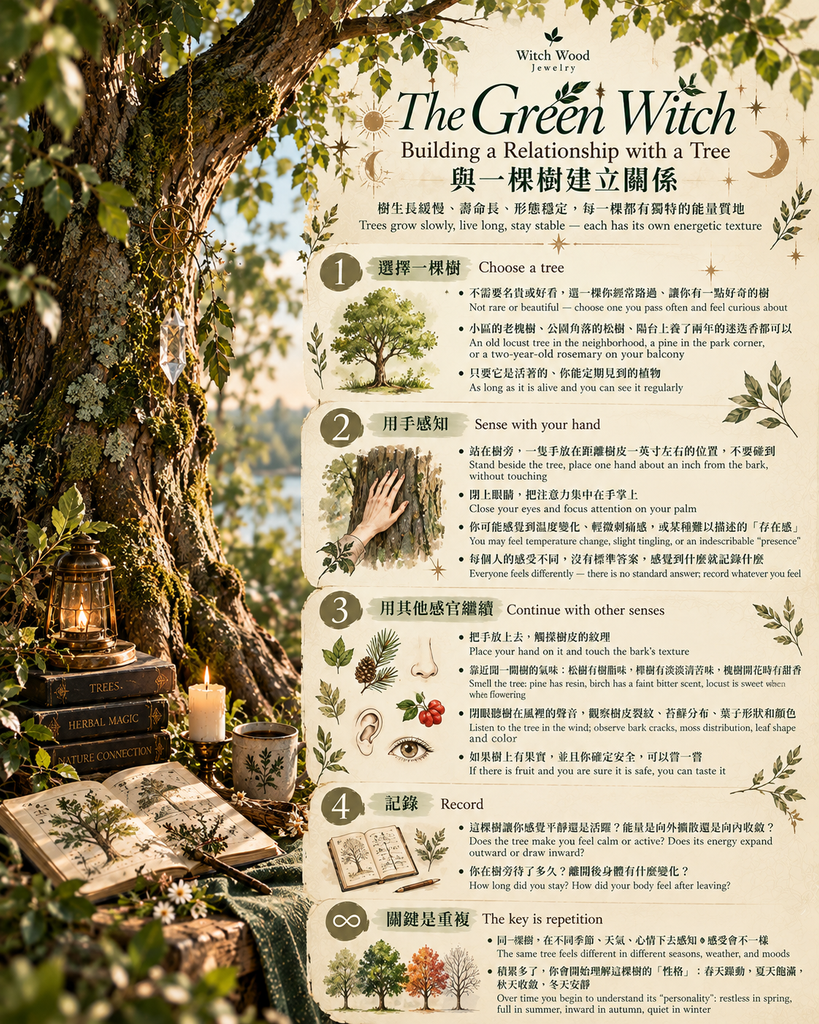
Building a Relationship with a Tree
Trees are one of the easiest “teachers” in nature to approach. They grow slowly, live long, and keep a stable shape. Each one has its own unique energy quality.
Step one: Choose a tree. It does not need to be a rare species or especially beautiful. Choose a tree you pass by often and feel a little curious about. Maybe it is the old locust tree in your neighborhood, a pine in the corner of a park, or the rosemary on your balcony that you have kept for two years—as long as it is alive and you can see it regularly.
Step two: Sense with your hand. Stand next to the tree and hold one hand about an inch away from the bark. Do not touch it yet. Close your eyes and focus your attention on your palm. You may feel a change in temperature, a slight tingling, or some hard-to-describe “presence.” Everyone feels something different. There is no standard answer. Record whatever you feel. Do not rush to judge whether it is right or wrong.
Step three: Continue with other senses. Place your hand on the bark and feel its texture. Lean in and smell the tree—pine has a resinous scent, birch has a faint bitter-green smell, locust is sweet when flowering. Close your eyes and listen to the sound the tree makes in the wind. Look at the cracks in the bark, the moss, the shape and color of the leaves. If the tree has fruit and you are sure it is safe, taste it.
Step four: Record. Write down all your observations. Does this tree make you feel calm or active? Does its energy spread outward or draw inward? How long did you stay beside it? How did your body feel after you left?
The key to this exercise is repetition. The same tree, sensed in different seasons, different weather, and different moods, will give you different impressions. Over time, you begin to understand the tree’s “character”—restless in spring, full in summer, gathering in autumn, quiet in winter.
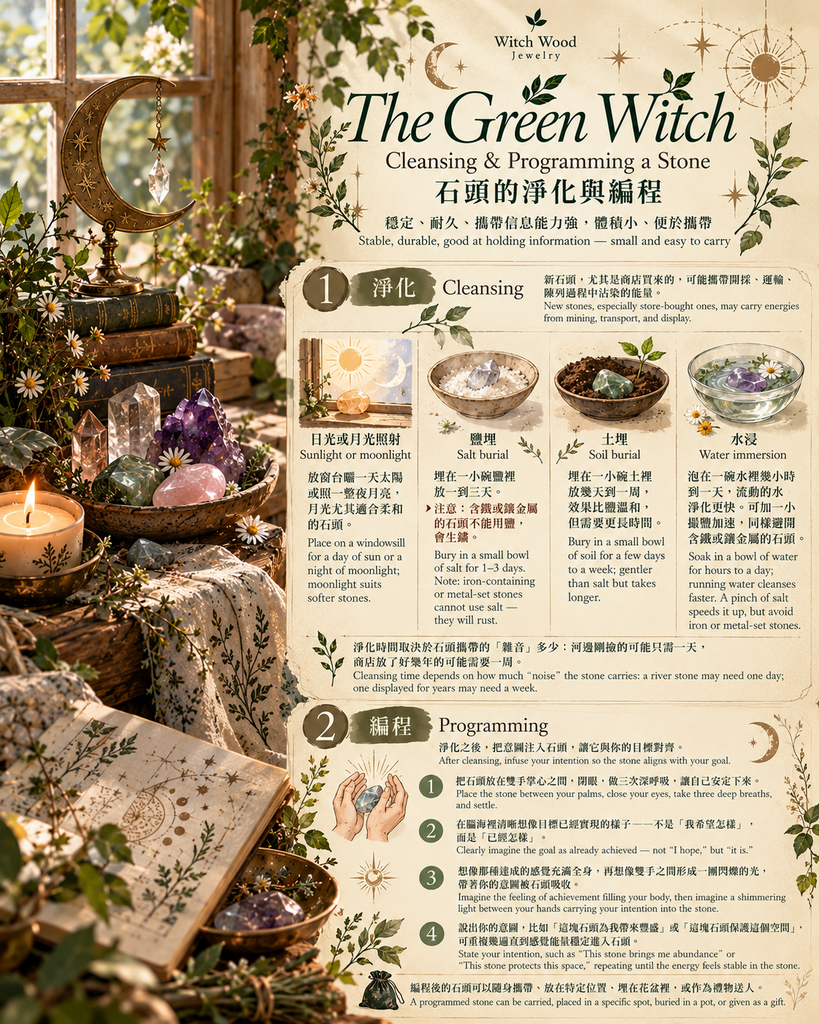
Cleansing and Programming Stones
Stones are “the bones of the earth.” They are stable, durable, good at holding information, and small enough to carry. They are one of the most commonly used tools in green witch practice.
Cleansing. A new stone, especially one bought from a shop, may carry various energies picked up during mining, transport, and display. Before use, it should be cleansed. There are several common methods:
- Sunlight or moonlight: Place the stone on a windowsill for a day of sun or a full night of moonlight. Moonlight is especially good for gentle stones.
- Salt burial: Bury the stone in a small bowl of salt for one to three days. Salt is a natural cleanser. Note: stones containing iron (such as hematite) or set in metal should not be cleansed with salt, as they will rust.
- Earth burial: Bury the stone in a small bowl of soil for a few days to a week. Gentler than salt, but takes longer.
- Water immersion: Soak the stone in a bowl of water for a few hours to a day. Running water cleanses faster. You can add a pinch of salt to speed the process, but again avoid iron-containing or metal-set stones.
How long cleansing takes depends on how much “noise” the stone carries. A stone just picked up from a river may only need a day in the sun. A stone that has sat in a shop for years may need a week.
Programming. After cleansing, a stone needs to be “programmed”—that is, filled with your intention so that it aligns with your goal.
Method: Hold the stone between your palms. Close your eyes and take three deep breaths to settle yourself. Then, in your mind, clearly picture your goal as already achieved—not “I hope it will be,” but “it already is.” Imagine the feeling of that achievement filling your body. Next, visualize a sparkling light forming between your hands. This light is the energy you are raising, carrying your intention. Imagine the light being absorbed into the stone. Finally, say your intention aloud, such as “This stone brings me abundance” or “This stone protects this space.” Repeat it a few times until you feel the energy has settled into the stone.
A programmed stone can be carried with you, placed in a specific spot, buried in a plant pot, or given as a gift.
Branches and Leaves: Reading a Tree’s Message
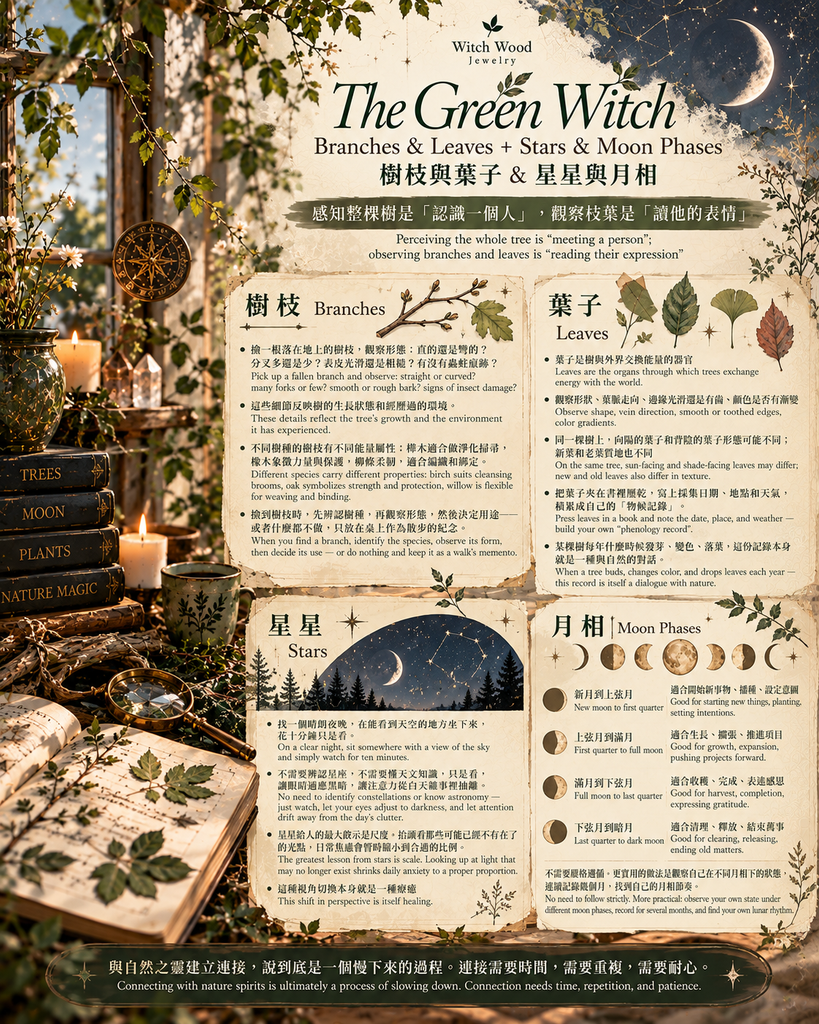
If sensing the whole tree is like “getting to know a person,” then observing branches and leaves is like “reading their expression.”
Branches. Pick up a branch from the ground. Observe its shape: straight or curved? Many forks or few? Smooth bark or rough? Any signs of insect damage? These details reflect the tree’s growing conditions and the environment it has lived through. A branch that has long bent in the wind will have a different grain direction from a straight-grown branch, and a different weight and flexibility in the hand.
In green witch tradition, branches from different trees carry different energy qualities. Birch twigs are suited to making cleansing brooms. Oak branches symbolize strength and protection. Willow is flexible and suited to weaving and binding. When you pick up a branch, first identify the tree, then observe its shape, then decide what it can be used for—or do nothing with it, and simply keep it on your desk as a reminder of a walk.
Leaves. Leaves are the organs through which a tree exchanges energy with the outside world. Observe a leaf: its shape, the direction of its veins, whether the edge is smooth or toothed, whether the color shifts across the surface. On the same tree, leaves facing the sun and leaves in shade may have different shapes. New leaves and old leaves have different textures.
Leaves can also be used for simple nature records. Press a leaf in a book to dry it, and write down the date, location, and weather when you collected it. Over time, you will build your own “phenology record”—when a certain tree buds, changes color, and drops its leaves each year. This record is itself a conversation with nature.
Stars and Moon Phases: Tuning Your Rhythm
Seeing stars in the city is not easy. Light pollution hides most of them in the background glow. But if you find a relatively dark spot—a rooftop, a deep corner of a park, the outskirts of town—you can still see some bright stars and constellations.
The star-watching exercise is simple: Find a clear night, sit somewhere with a view of the sky, and spend ten minutes just looking. No need to identify constellations. No need for astronomical knowledge. Just look. Let your eyes adjust to the dark. Let your attention slowly pull away from the day’s chores. If you like, record how many stars you see, their brightness, their positions, and how you feel.
The greatest lesson the stars offer is scale. When you look up at points of light that may no longer exist, daily anxieties shrink temporarily to a proper proportion. This shift in perspective is itself a form of healing.
Moon phases affect life on Earth more directly. Traditionally, the waxing and waning cycle has been used to guide sowing, harvesting, and various activities:
- New moon to first quarter: Good for starting new things, sowing, setting intentions.
- First quarter to full moon: Good for growth, expansion, pushing projects forward.
- Full moon to third quarter: Good for harvest, completion, expressing gratitude.
- Third quarter to dark moon: Good for clearing, releasing, ending old matters.
You do not need to follow these correspondences strictly. A more practical approach is: observe your own state under different moon phases. Some people feel energized and sleepless at the full moon. Some feel more tired and quiet at the new moon. Record your state for a few months, and you will find your own lunar rhythm. Then you can use it to arrange work, rest, and important decisions.
In Closing
Building a connection with nature spirits is, at its core, a process of slowing down. A tree will not fully open to you the first time you approach. A stone will not respond the moment you first pick it up. The stars will certainly not change position because you are watching them. Connection takes time, repetition, and patience.
But once it is established, this connection is lasting. It does not depend on a specific place, specific tools, or a specific ritual. You can observe a tree’s changes on your commute. You can touch the stone you brought back from a river while standing on your balcony. You can spend two minutes before bed looking at the moon outside your window. These small actions, accumulated over time, form a continuous channel of conversation with nature.
References
- Murphy-Hiscock, A. (2006). The way of the green witch: Rituals, spells, and practices to bring you back to nature. Provenance Press.
- Cunningham, S. (2000). Cunningham’s encyclopedia of magical herbs (2nd ed.). Llewellyn Publications.
- Green, M. (2002). Wild witchcraft: A guide to natural, herbal and earth magic. Thorsons.
- Beyerl, P. (1998). A compendium of herbal magick. Phoenix Publishing.
- Cowan, E. (1995). Plant spirit medicine. Swan, Raven & Company.

