
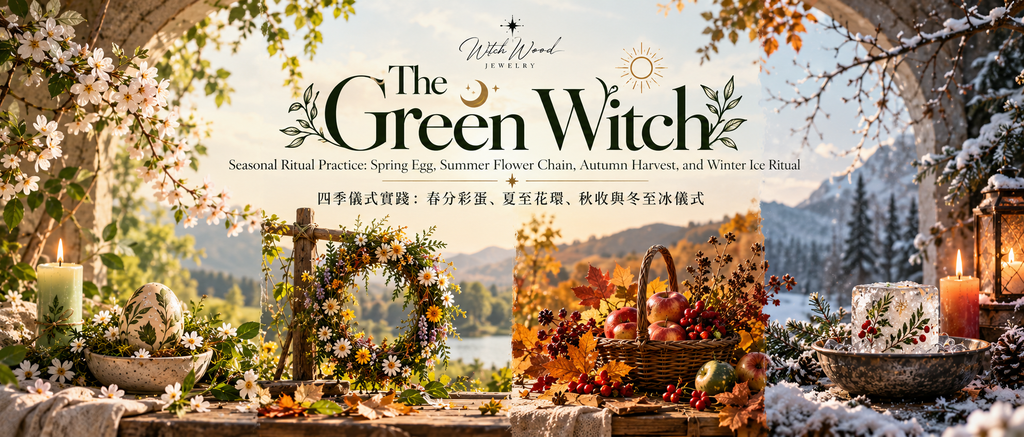
Meditation is one way to talk with the energy of the seasons. Ritual is another.
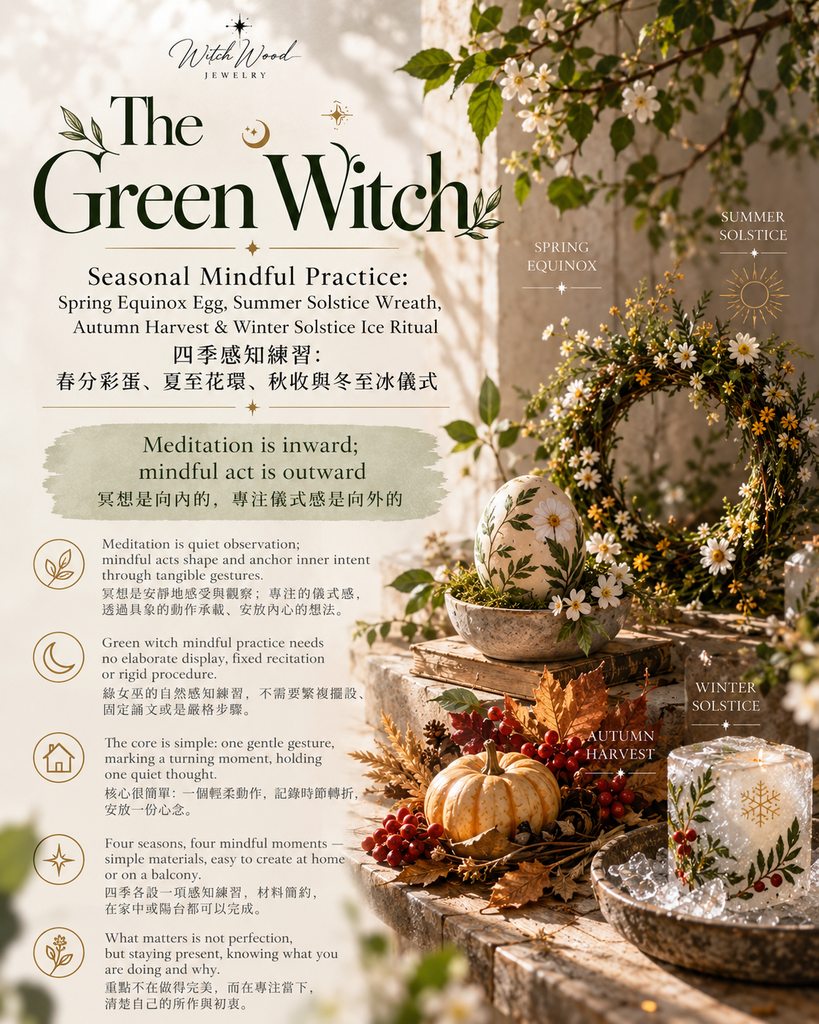
Meditation is inward—quietly sensing and observing. Ritual is outward—using a concrete action to express and fix an intention in place. A green witch’s ritual does not need a complicated altar, fixed words, or a strict procedure. Its core is simple: use one action to mark one moment and express one intention.
This article gathers one ritual for each of the four seasons. None of them are complicated. The materials are easy to find, and they can be done at home or on a balcony. What matters is not doing them perfectly, but knowing what you are doing and why while you do it.
Spring Equinox: Egg Ritual for Welcoming Creative Energy
The spring equinox is the moment of balance and emergence. Day and night are equal, but from this day forward, light begins to gain the upper hand. Seeds wake underground, roots extend, and life shifts from hidden to visible.
This ritual uses the “emerging” energy of spring to direct it toward an area of your life that needs to be started—a new plan, a new relationship, a new habit.
Materials:
- One raw egg, colored according to your intention (for example: brown or orange for career, red or pink for love, green for health)
- One small pale green candle
- One small piece of parchment or blank paper
- A pen
- A small heatproof dish
Steps:
- Find a quiet space and set up a simple sacred space. This can be as simple as lighting the candle, taking three deep breaths, and telling yourself, “I am beginning now.”
- Light the candle. Hold the egg in both hands and say aloud (or silently) your intention. For example: “Maiden of Spring, goddess of light and life; young Sun God, full of joy and energy. Bless this egg and fill it with the power of spring—the energy of life, creation, and emergence. May my life be set in motion.”
- Place the egg beside the candle.
- Write on the paper the specific area of your life where you want to direct this creative energy. When you finish writing, hold the paper between your hands and fill it with your need.
- Carefully touch one corner of the paper to the candle flame until it catches fire. Place it in the heatproof dish and let it burn completely to ash.
- Let the candle burn out on its own. Leave the egg beside it.
- When the candle has gone out, take the egg and the ashes outside. Dig a hole in the earth. Place the egg in the hole, sprinkle the ashes on top, and cover it with soil. The energy of the egg and the earth will slowly begin to work on the area you set.
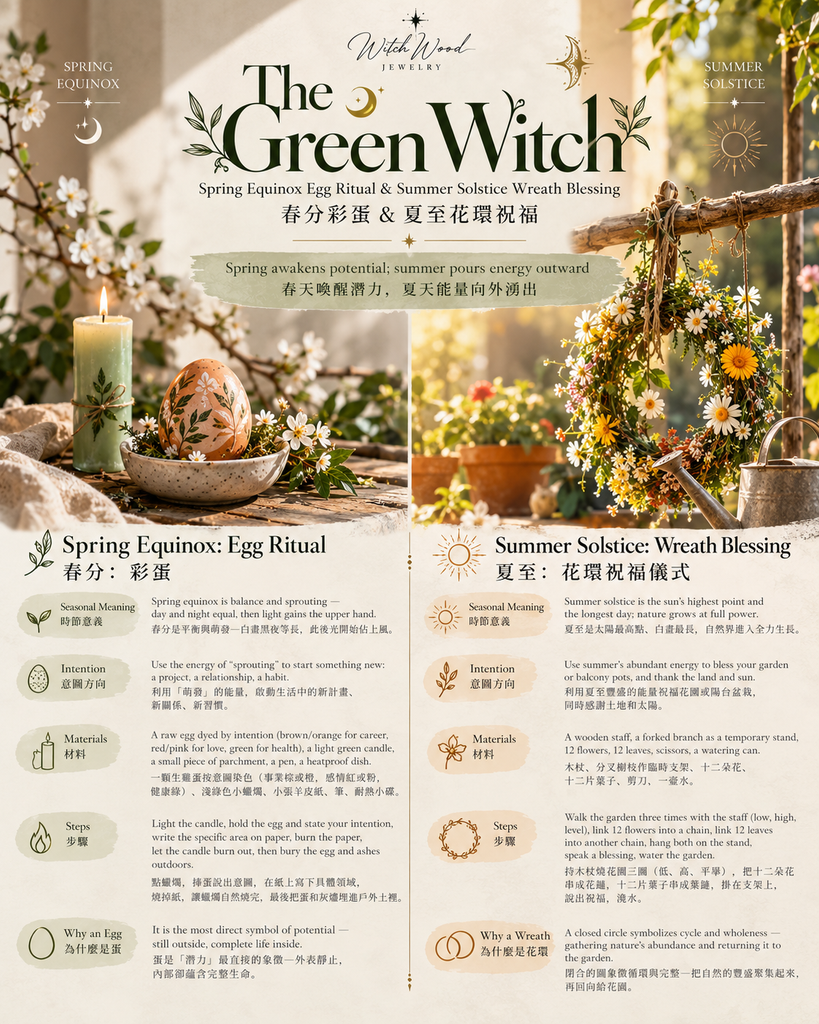
Why an egg: The egg is nature’s most direct symbol of potential—still on the outside, but holding a complete life within. The energy of the spring equinox is the same: the change is not yet obvious on the surface, but something underneath has already begun to move.
Summer Solstice: Flower Chain Blessing Ritual for the Garden
The summer solstice is the highest point of the sun and the longest day. The natural world enters full growth, with energy pouring outward, upward, and in all directions.
This ritual uses the abundant energy of summer to bless your garden (or balcony pots) with life force, while also giving thanks to the earth and the sun.
Materials:
- A wooden staff or walking stick
- A forked branch (as a temporary stand)
- Twelve flowers (gathered from your garden or the wild; stems at least 10 cm long; avoid toxic plants)
- Twelve leaves (as large as possible, with firm stems)
- Scissors or a small knife
- A pitcher of water
Steps:
- Hold the staff and walk around your garden (or balcony). On the first round, hold the staff low, near the ground, and visualize life force rising from the soil through the roots to the stems, leaves, flowers, and fruit. On the second round, hold the staff high and visualize sunlight and rain nourishing the plants from above. On the third round, hold the staff horizontally and visualize the life force of each plant expanding outward, connecting with the plants around it, forming a whole.
- Set the staff aside. Push the forked branch into the soil with the fork facing up, as a temporary stand.
- Sit or kneel in front of the stand and pick up the first flower. Remove the leaves from the stem and trim it to about 15 cm. Make a small slit in the stem about 2 to 3 cm below the petals, using your fingernail or a small knife.
- Pick up the second flower. Insert the end of its stem into the slit of the first flower. Carefully pull the second stem through the slit until the two slits lock together.
- Pick up the third flower and insert its stem into the slit of the second flower. Repeat until all twelve flowers are joined into a chain.
- Hang the flower chain on the forked stand, laying each end over one of the forks so the middle hangs in a gentle curve.
- Make a tiny slit in the stem of each leaf.
- Pick up the first leaf. Insert the stem of the second leaf into the slit of the first, pull it through, and repeat until all twelve leaves are joined into another chain.
- Hang the leaf chain on the stand as well, laying it along the flower chain. If it is not long enough, wrap it around the fork or twine it around the flower chain.
- Place both hands on the chains and say: “Powers of wind and earth, powers of sun and rain: by tree and flower and leaf, with my hands and heart, I bless this garden with life and love.”
- Take up the pitcher of water and walk around the garden, gently sprinkling water. Return to the stand and pour the last of the water at the base where it enters the soil, saying: “I give thanks to the earth for its abundant giving, its protection, and its support. May the earth and all who walk upon it be blessed.”
- If you like, sit in the garden for a while, or do some gardening work. Leave the chains on the stand for at least a day. When they have wilted, remove them and add them to the compost.
Why a flower chain: A chain is a closed circle, a symbol of cycle and wholeness. Stringing flowers and leaves into a chain and hanging it on a stand is an act of gathering the abundance of nature and then returning it to the garden.
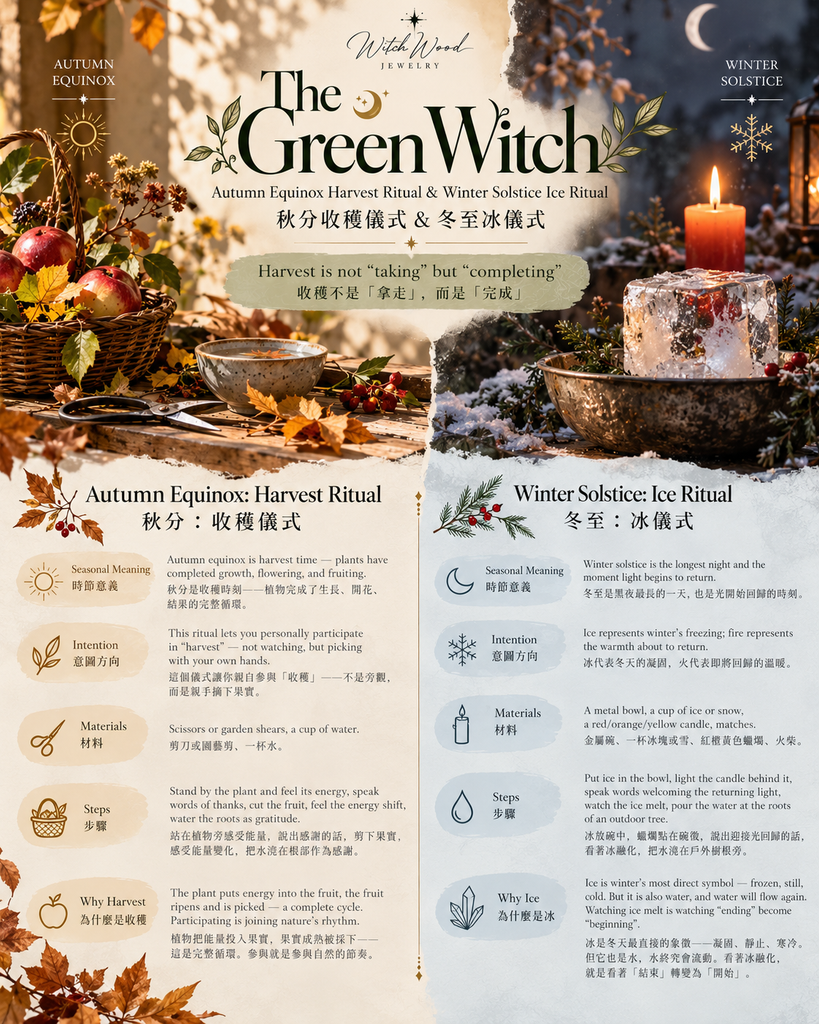
Autumn Equinox: Harvest Ritual—Taking Part in the Season’s Completion
The autumn equinox is the time of harvest. From spring equinox to summer solstice, plants have completed the full cycle of growth, flowering, and fruiting. Now it is time to gather, and also time to begin drawing inward.
This ritual lets you take part in the act of harvesting. Not watching from the side, but picking the fruit with your own hands, feeling the turn from growth to completion.
Materials:
- A pair of scissors or garden shears
- A cup of water
Steps:
- Stand beside the plant you are going to harvest. Reach out your hand and sense the plant’s energy.
- Say: “I honor you, child of the earth. I honor your growth, your flower, and now your fruit. I thank you for your energy. May you be blessed, child of the earth. May I, who harvest your fruit, also be blessed by this act.”
- Cut the fruit with the scissors. Sense the change in the plant’s energy before and after the harvest.
- Pour the water at the base of the plant as thanks.
Why harvest: Harvesting is not “taking.” It is “completing.” The plant has put its energy into the fruit, the fruit has ripened, and now it is picked—this is a full cycle. To take part in this act is to take part in the rhythm of nature.
Winter Solstice: Ice Ritual—Remembering That Spring Will Come
The winter solstice is the longest night, and also the moment when light begins to return. On the surface everything is still, but underground, seeds are waiting.
This ritual uses ice and fire as a contrast: ice represents the freezing of winter, fire represents the warmth that is coming back. Watching ice slowly melt beside a candle flame is a concrete reminder—spring will come.
Materials:
- A metal bowl (metal reflects candlelight)
- A cup of ice cubes or snow
- A red, orange, or yellow candle
- Matches or a lighter
Steps:
- Place the ice or snow in the metal bowl. Light the candle and place it behind the bowl so the flame reflects on the ice or snow.
- Say: “As the season turns and the sun shines, I greet the light returning to the land. Darkness fades, light flows again, and day by day the land will grow warm. Welcome back, bright sun! May your beams soothe the land and turn ice to water, snow to rain, cold to warmth, and winter to spring.”
- Watch the ice or snow slowly melt. Look at the candle flame reflected on the water. Feel the contrast between the cold of the ice and the warmth of the flame.
- When the ritual is over, pour the water outside at the base of a tree.
Why ice: Ice is the most direct symbol of winter—frozen, still, cold. But it is also a form of water, and water will flow again. Watching ice melt is watching “ending” turn into “beginning.”
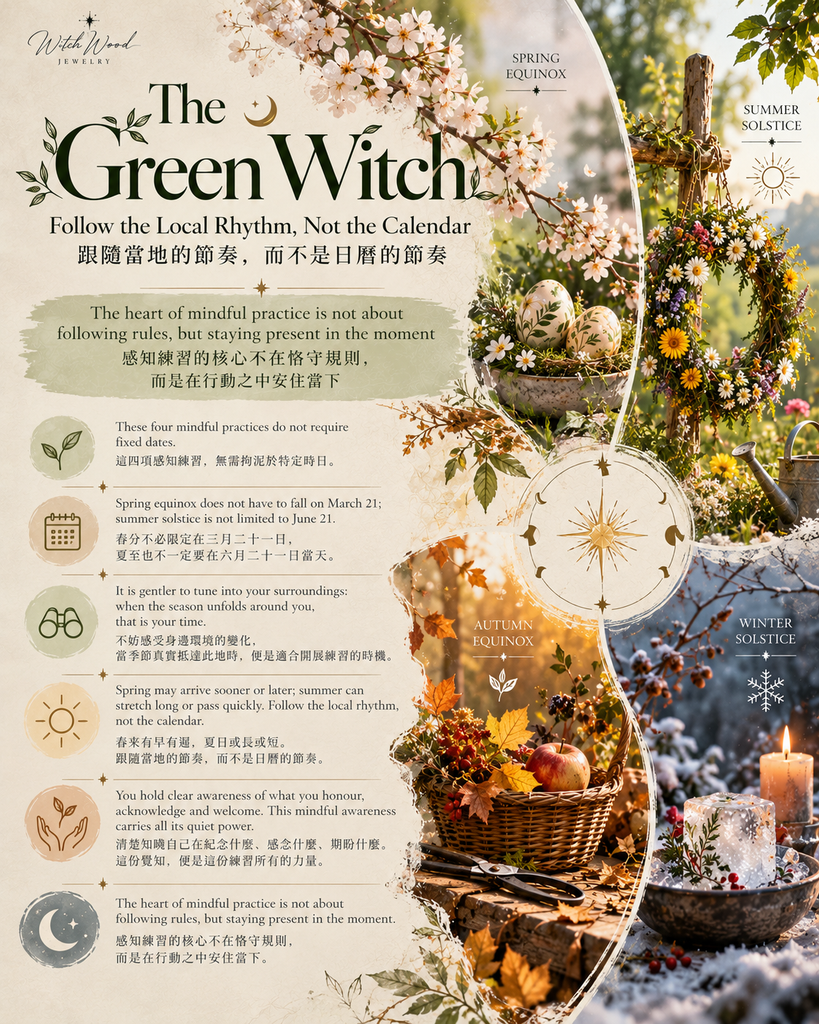
These four rituals do not need to be done on exact dates. The spring equinox does not have to be done on March 21, and the summer solstice does not have to be done on June 21. A better approach is: observe where you live, and do the ritual on the day the season truly arrives. Spring may come early or late. Summer may be long or short. Follow the local rhythm, not the calendar rhythm.
The meaning of ritual is not in “doing it right.” It is in “being present while you do it.” You know what you are marking, what you are thanking, and what you are hoping for. This awareness is the whole power of the ritual.
References
- Murphy-Hiscock, A. (2006). The way of the green witch: Rituals, spells, and practices to bring you back to nature. Provenance Press.
- Cunningham, S. (2000). Cunningham’s encyclopedia of magical herbs (2nd ed.). Llewellyn Publications.
- Green, M. (2002). Wild witchcraft: A guide to natural, herbal and earth magic. Thorsons.
- Beyerl, P. (1998). A compendium of herbal magick. Phoenix Publishing.
- Cowan, E. (1995). Plant spirit medicine. Swan, Raven & Company.

