
Many people treat cooking as a chore—shop, wash, chop, cook, eat, wash up. The faster the whole thing is over, the better. Twenty minutes is ideal.
But in the green witch tradition, cooking is one of the easiest places to connect with nature during the day. The vegetables and fruits in your hands are living things that grew from the soil, absorbing sunlight and rain. When you handle them, heat them, and finally eat them, you are completing a transfer of energy from nature to your body.
This article is about how to turn that process from “getting a task done” into “being present while doing it.” No complicated rituals, no special tools. Just knowing what you are doing and why, while you chop and season.
Why “Seasonal”?
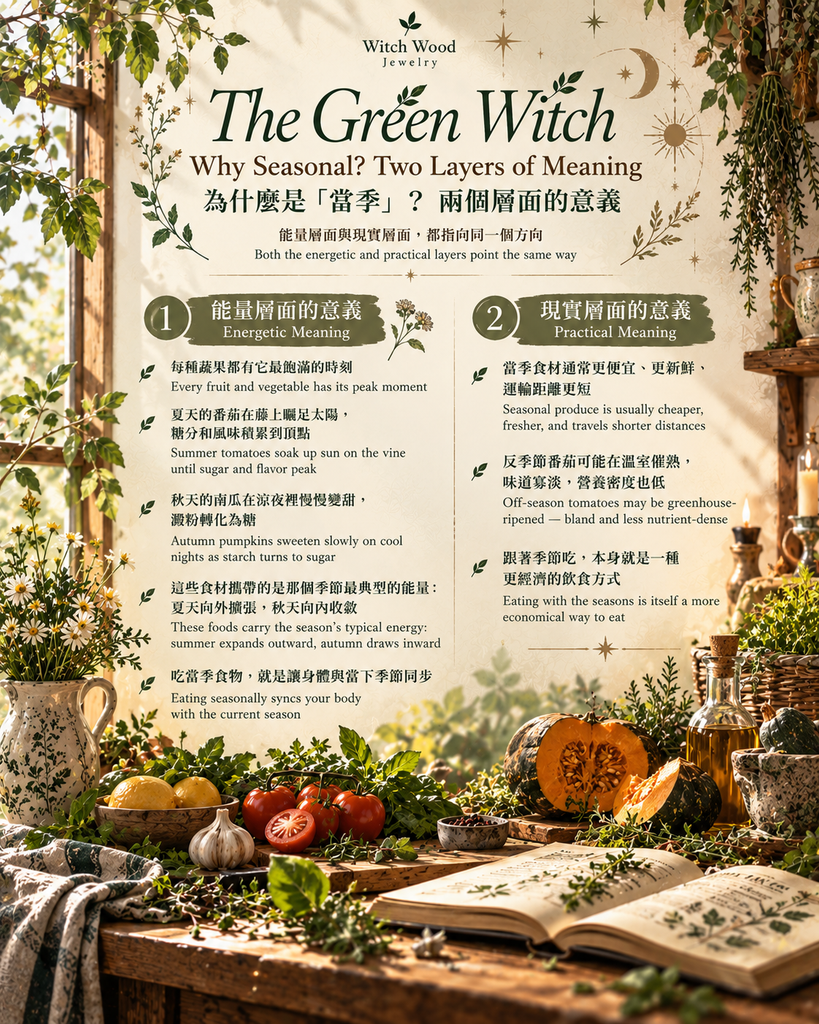
Seasonal food matters on two levels.
First, the energy level. In the natural rhythm of growth, every fruit and vegetable has a moment when it is at its fullest. Summer tomatoes ripen on the vine under long hours of sun, building up sugar and flavor. Autumn pumpkins slowly sweeten as the nights turn cool, their starch turning to sugar. Food at these moments carries the most typical energy of that season—the outward push of summer, the inward gathering of autumn. Eating seasonal food is a way of bringing your body into step with the season you are in.
Second, the practical level. Seasonal food is usually cheaper, fresher, and travels a shorter distance. Out-of-season tomatoes may be grown in greenhouses and picked early, with weak flavor and lower nutritional density. From a practical standpoint, eating with the seasons is simply a more economical way to eat.
The Energy of Common Fruits and Vegetables
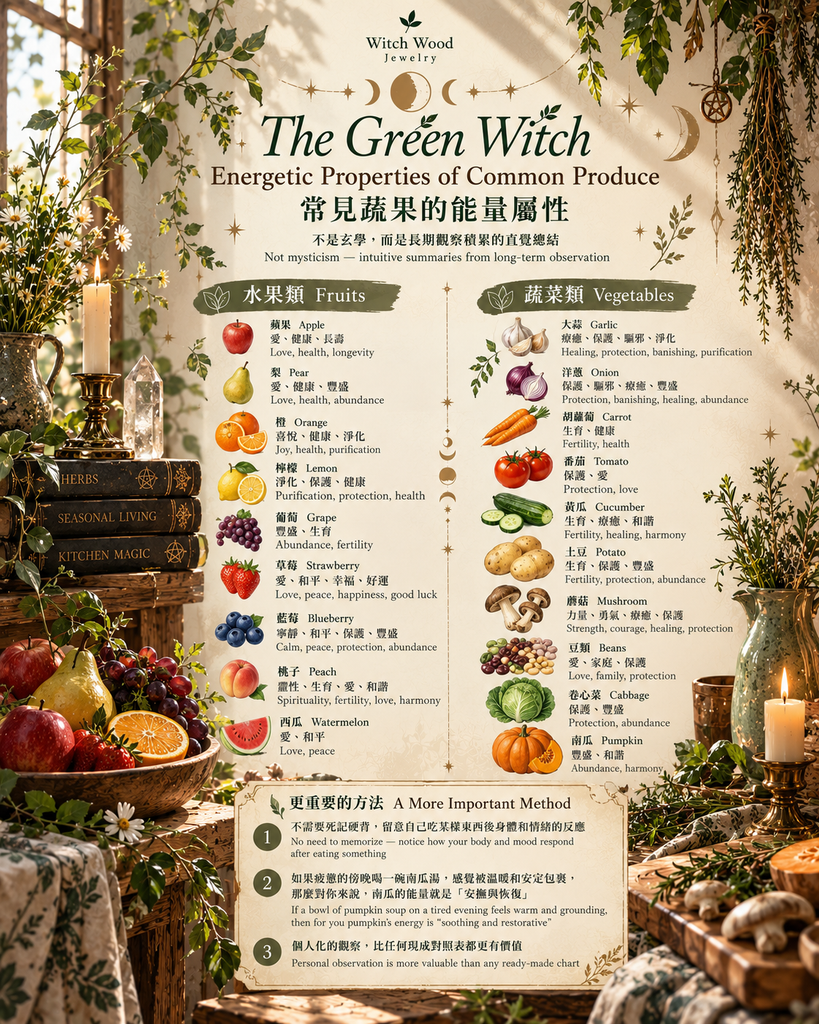
In the green witch tradition, every plant has its own energy quality. These are not abstract beliefs. They are intuitive summaries built up over long observation—what happens to the body and mood after eating a certain food. Here are some common correspondences:
Fruits:
- Apple: love, health, long life
- Pear: love, health, abundance
- Orange: joy, health, purification
- Lemon: purification, protection, health
- Grape: abundance, fertility
- Strawberry: love, peace, happiness, good luck
- Blueberry: calm, peace, protection, abundance
- Peach: spirituality, fertility, love, harmony
- Watermelon: love, peace
Vegetables:
- Garlic: healing, protection, banishing, purification
- Onion: protection, banishing, healing, abundance
- Carrot: fertility, health
- Tomato: protection, love
- Cucumber: fertility, healing, harmony
- Potato: fertility, protection, abundance
- Mushroom: strength, courage, healing, protection
- Beans: love, family, protection
- Cabbage: protection, abundance
- Squash: abundance, harmony
You do not need to memorize these. A better method is this: when you eat something, notice how your body and mood respond. If you drink a bowl of pumpkin soup on a tired evening and feel wrapped in warmth and calm, then for you, the energy of pumpkin is “soothing and restoring.” This kind of personal observation is more valuable than any ready-made table.
Three Simple Seasonal Meals
The following three dishes correspond to summer, autumn, and winter. They are simple to make and use easy-to-find ingredients.
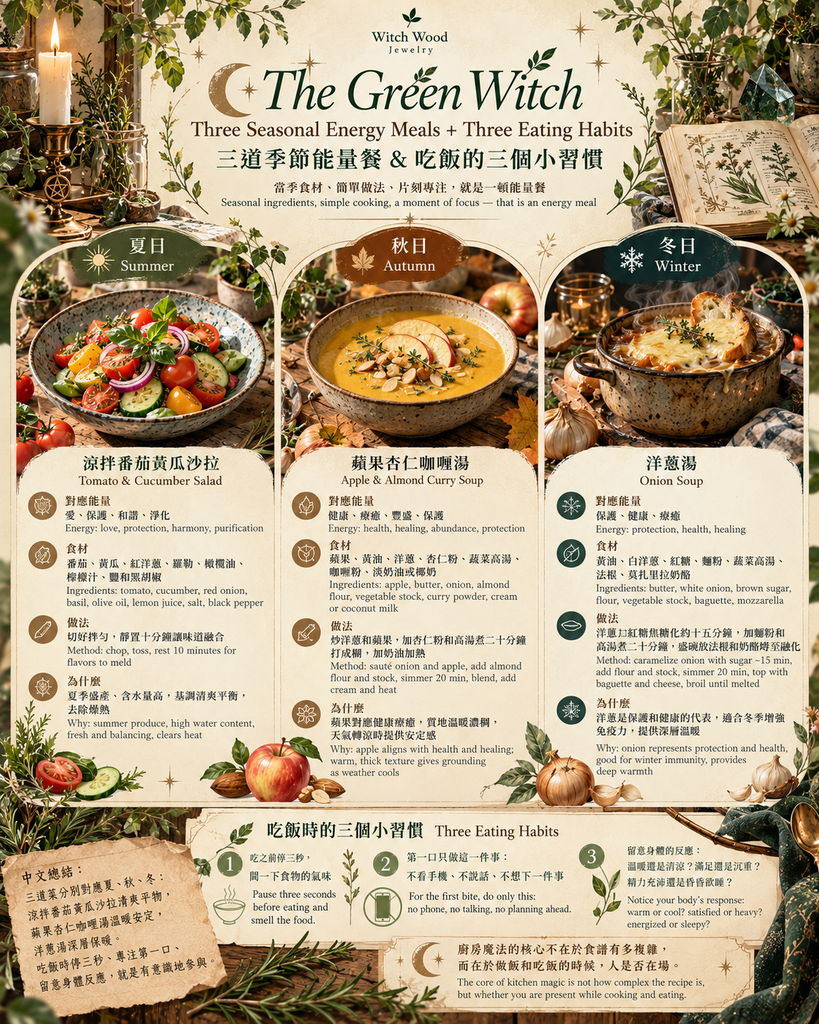
Summer: Tomato and Cucumber Salad
Energy: love, protection, harmony, purification
Ingredients:
- Two tomatoes, cut into chunks
- One cucumber, sliced
- A quarter of a red onion, thinly sliced
- A small handful of fresh basil leaves
- Two tablespoons of olive oil
- One tablespoon of lemon juice
- Salt and black pepper to taste
Method:
- Put the tomatoes and cucumber in a large bowl.
- Soak the onion slices in cold water for five minutes to remove the sharp bite. Drain and add to the bowl.
- Add the basil, olive oil, lemon juice, salt, and pepper. Toss gently.
- Let it sit for ten minutes so the flavors come together. Serve.
Why this dish: Tomatoes and cucumbers are both at their peak in summer. They are high in water, which helps in hot weather. Tomato corresponds to “protection” and “love,” cucumber to “harmony,” lemon to “purification.” The overall tone is fresh, balanced, and cooling.
Autumn: Apple, Almond, and Curry Soup
Energy: health, healing, abundance, protection
Ingredients:
- Three apples, peeled, cored, and chopped
- Two tablespoons of butter
- One onion, finely chopped
- Three tablespoons of ground almonds
- Four cups of vegetable stock
- Half a teaspoon of curry powder
- Salt and black pepper to taste
- Half a cup of light cream or coconut milk
- A few toasted almond slices for garnish
Method:
- Melt the butter in a pot. Add the onion and cook over medium heat until soft, about five minutes.
- Add the apples and stir gently for two to three minutes.
- Sprinkle in the ground almonds and stir for another one to two minutes.
- Pour in the stock and bring to a boil. Add salt and pepper.
- Lower the heat, cover, and simmer for twenty minutes until the apples are tender.
- Remove from heat and let cool slightly. Blend until smooth.
- Return to the pot. Add the cream or coconut milk and heat gently without boiling. If too thick, add a little more stock.
- Serve in bowls, topped with toasted almond slices.
Why this dish: Apple is the representative fruit of autumn, corresponding to “health” and “healing.” Almond corresponds to “abundance,” curry to “protection.” The soup is warm and thick, giving the body a sense of steadiness as the weather turns cool.
Winter: Onion Soup
Energy: protection, health, healing
Ingredients:
- Four tablespoons of butter
- Four to six white onions, thinly sliced
- Two tablespoons of brown sugar
- Two tablespoons of flour
- Four cups of vegetable stock
- Salt and black pepper to taste
- Two tablespoons of sherry or port (optional)
- Slices of French bread
- One cup of grated mozzarella
- A little chopped fresh parsley
Method:
- Melt the butter in a pot. Add the onions and brown sugar. Cook over medium-high heat, stirring constantly, for about fifteen minutes, until the onions are caramel-colored and soft.
- Sprinkle in the flour and stir to combine.
- Slowly pour in the stock, stirring as you go. Bring to a boil.
- Add salt, pepper, and parsley.
- Lower the heat, cover, and simmer for twenty minutes, stirring occasionally.
- If using sherry or port, add it now and cook for another two minutes.
- Ladle into heatproof bowls. Top with a slice of bread and a handful of cheese.
- Place under the broiler for one to two minutes, until the cheese melts and bubbles.
Why this dish: Onion is traditionally associated with “protection” and “health,” especially useful in winter for supporting the immune system. The long caramelizing brings out the onion’s sweetness fully. With cheese and stock, it is a dish that gives deep warmth to the body.
Three Small Habits While Eating
After cooking, the eating matters too. These three habits take no extra time. They only take a little attention.
First, pause for three seconds before eating. Before you pick up your bowl or chopsticks, pause for three seconds and smell the food. This small action helps the body shift from “getting ready to eat” to “actually eating.”
Second, make the first bite the only thing you do. For the first bite, do not look at your phone, do not talk, do not think about the next task. Just chew. Notice the taste and texture. When that bite is done, continue eating normally.
Third, notice how your body responds. After eating, take one minute to check in with your body. Do you feel warm or cool? Satisfied or heavy? Energized or sleepy? Over time, this kind of observation helps you learn which foods suit you best in which states.
The heart of kitchen magic is not how complicated the recipe is. It is whether the person is present while cooking and eating. The same tomatoes and cucumbers, chopped and eaten absent-mindedly, and handled and tasted with awareness, are two completely different experiences. The first is just taking in calories. The second is an exchange with nature.
Seasonal ingredients, simple methods, and a moment of focus while eating—these three things together already make a meal of energy.
References
- Murphy-Hiscock, A. (2006). The way of the green witch: Rituals, spells, and practices to bring you back to nature. Provenance Press.
- Cunningham, S. (2000). Cunningham’s encyclopedia of magical herbs (2nd ed.). Llewellyn Publications.
- Green, M. (2002). Wild witchcraft: A guide to natural, herbal and earth magic. Thorsons.
- Beyerl, P. (1998). A compendium of herbal magick. Phoenix Publishing.
- Cowan, E. (1995). Plant spirit medicine. Swan, Raven & Company.

