
In the human spiritual experience, there is an ancient and universally recognized phenomenon—after experiencing severe trauma, emotional shock, or a major life transition, individuals often feel as though “a part of themselves has been lost.” This feeling is not merely imagination. In shamanic traditions around the world, it is systematically explained and addressed through a practice known as “soul retrieval” or “soul fragment recovery.” This article systematically introduces the three-world structure of shamanic cosmology, the fundamental principles behind the formation of soul fragments, and how lost life energy can be reclaimed through conscious journeying.

The Three Shamanic Worlds: A Structural Map of the Spiritual Realms
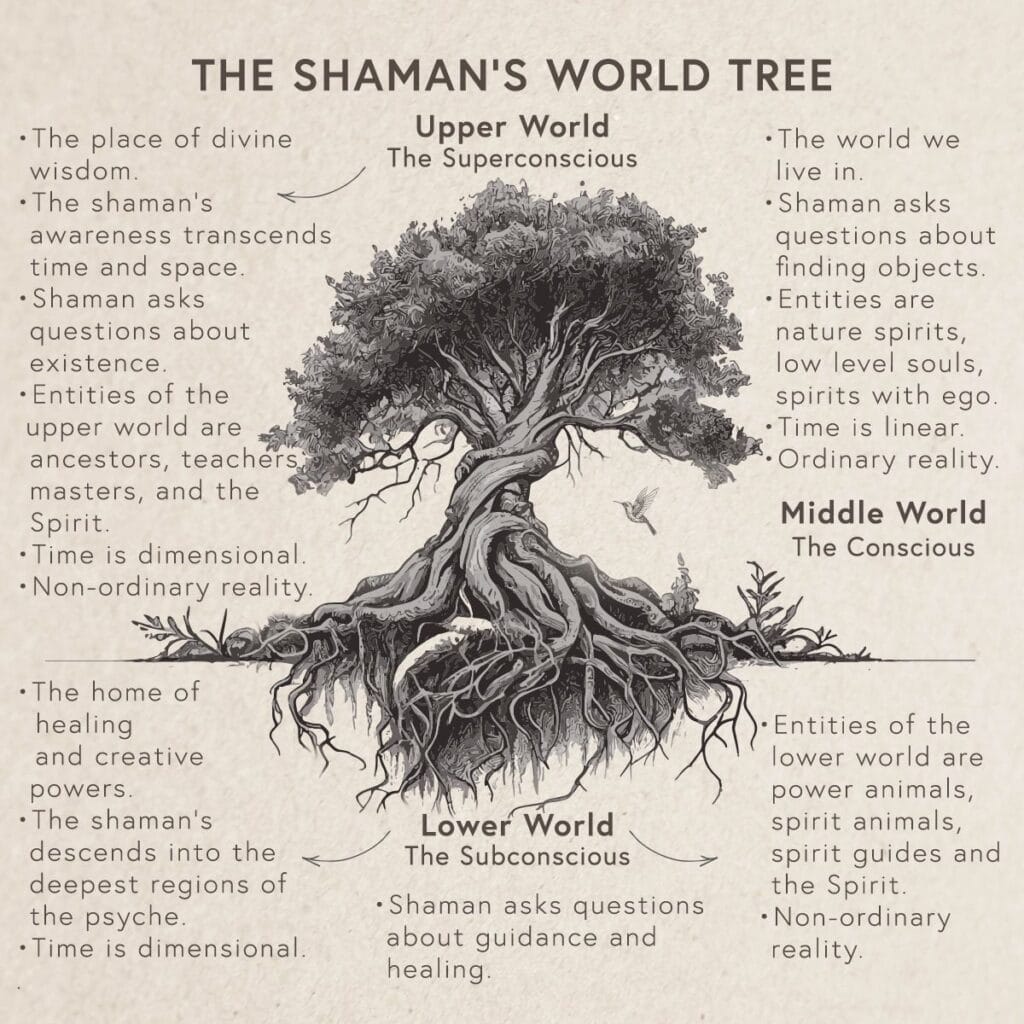
In shamanic cosmology, the spiritual world is divided into three primary realms, known as the Lower World, the Middle World, and the Upper World. These three worlds are not physical locations but different dimensions of consciousness, each carrying specific spiritual forces and healing resources.
The Lower World is the most frequently entered realm in shamanic journeying. It lies deep beneath the earth, connected to the roots of trees. The Lower World is inhabited by animal spirits, Power Animals, totem allies, and ancestral wisdom. When an individual needs to draw strength from an animal ally or establish a connection with ancestors, they typically journey to the Lower World. The energy of the Lower World is deeply rooted in the earth, characterized by primal, instinctual, and ancient wisdom.
The Middle World is the spiritual counterpart of the physical world. It exists within the energy field of ordinary reality and contains the spiritual essence of all things in nature—the spirit of crystals, the soul of plants, the energetic forms of mountains and rivers. The Middle World is also the primary realm for soul retrieval journeys, because the soul fragments left behind by trauma typically remain lodged at specific nodes of time and space within this dimension. The energy of the Middle World is closest to everyday life, while still connecting with the spiritual dimensions of the material world.
The Upper World is the realm where spiritual energy is purest and vibrates at the highest frequency. The Upper World is inhabited by ascended masters, angels, guides, and beings of light. When individuals seek spiritual guidance, higher wisdom, or blessings that transcend personal limitations, they typically journey to the Upper World. The energy of the Upper World is light, luminous, and filled with loving vibration and pure awareness.
These three worlds are not isolated from one another. They are connected through energetic channels in nature—such as trees, cave openings, and rivers. Shamans enter these channels to traverse the three realms during conscious journeying, accessing different healing resources from each.
Soul Fragments: How Trauma Creates Energetic Fractures
The core concept of soul retrieval is the soul fragment. According to this theory, when an individual experiences severe trauma—such as the death of a loved one, a major separation, physical or emotional abuse, or a sudden disaster—consciousness activates a “fracturing” mechanism under extreme stress. This mechanism separates a portion of energy from the complete self to prevent the entire psychological system from being overwhelmed.
This process can be understood as follows: when the psyche receives an impact beyond its capacity to bear, it leaves a portion of its energy at the time and place where the trauma occurred, allowing that part of the “self” to remain there while the rest of the self continues forward. In the short term, this separation may serve a protective function, enabling the individual to continue functioning. However, in the long term, it leads to a range of issues: inner emptiness, inability to form deep intimate relationships, a sense of disconnection from oneself, inability to let go of the past, emotional volatility, chronic fatigue, and more.
The purpose of soul retrieval is to consciously enter the time and space of the trauma at the level of awareness, find the energetic fragment left behind, and reintegrate it into the present self. This process is not simply “recalling the trauma.” Rather, it is a return visit to past experiences under safe conditions and guided support, with more mature awareness, bringing the lost part back into the present with understanding and compassion.

Primary Methods of Soul Retrieval: Three Pathways
Depending on the nature of the trauma and the condition of the individual, soul retrieval can be accomplished through different approaches. The following are three primary pathways:
1. Self-Guided Soul Retrieval
Individuals with a foundational understanding of shamanic journeying techniques can perform soul retrieval independently. The basic procedure is as follows: set a clear intention (e.g., “I wish to retrieve the part of myself lost during a specific event”), enter a quiet and undisturbed environment, enter a conscious journey through specific meditation or drumming guidance, travel to the Middle World to locate the time-space node of the trauma, find and embrace the energetic fragment, and bring it back to integrate into the present self. This method is suitable for individuals with meditation experience and adequate psychological self-awareness.
2. Practitioner-Guided Soul Retrieval
This is the most traditional method, in which an experienced shaman or healer performs soul retrieval on behalf of the client. During the process, the healer journeys to the Middle World in consciousness, locates the time-space node of the trauma, retrieves the soul fragment, and then “blows” the energy into the client’s energy field through specific techniques—typically involving breath and focused intention. The advantage of this method is that the client does not need journeying experience and can receive healing in a state of complete relaxation and openness. The healer also shares the images and information received during the journey with the client, helping them understand what occurred.
3. Physical Location-Based Soul Retrieval
In certain cases, the energetic fragments left behind by trauma are highly associated with specific physical locations. Individuals can conduct energy recovery in person by visiting the location itself—such as a childhood home, the site of an accident, or another meaningful place. By being physically present at the site, quietly connecting with their feelings, setting an intention for retrieval, and departing with gratitude, individuals can complete a form of soul retrieval on the physical plane. This method is suitable for cases where the trauma node is clearly defined and closely connected to a specific location.

The Integration Phase: The True Beginning of Healing
Soul retrieval does not end with the recovery of the energetic fragment. The true integration occurs in the days following the retrieval. After a soul fragment is reincorporated into the energy field, the individual may experience a series of temporary reactions: emotional fluctuations, fatigue, changes in sleep patterns, and the emergence of old memories. These phenomena indicate that old and new energies are merging and are a normal and necessary part of the integration process.
During the period following retrieval, the individual needs to give themselves extra attention and care. Adequate rest, quiet time, appropriate physical release (such as gentle exercise or breathwork), and journaling can all support the integration process. It is also important to note that the self-awareness and emotional releases that emerge after soul retrieval often carry significant meaning and should be respected and taken seriously.

The Modern Relevance of Soul Retrieval: Self-Integration in the Context of Trauma
In contemporary society, the concept of soul retrieval holds particular relevance. The pressures of modern life, relationship ruptures, identity crises, and loss of meaning can all be understood as forms of “soul fragmentation.” Although modern psychology and psychiatry offer various explanations and treatment approaches for these struggles, soul retrieval provides a unique perspective—it emphasizes that trauma and healing possess profound spiritual significance and are not merely symptoms to be eliminated.
Whether through traditional shamanic journeying or through self-integration work within a psychotherapeutic framework, soul retrieval is fundamentally a process of guiding the individual back to wholeness. It teaches that the parts that seem lost have not truly disappeared—they have merely been temporarily placed in a specific time and space. As long as one is willing, they can be found, brought back, and reintegrated into the complete self. In this sense, soul retrieval is not merely an ancient technique. It is an eternal wisdom about human resilience and the return to wholeness.
References
- Charman, R. (2023). Crystal shamanism: Sacred earth medicine healings. Rockpool Publishing.
- Ingerman, S. (2016). Soul retrieval: Mending the fragmented self. Sounds True.
- Walsh, R. (1990). The spirit of shamanism. Jeremy P. Tarcher.

