
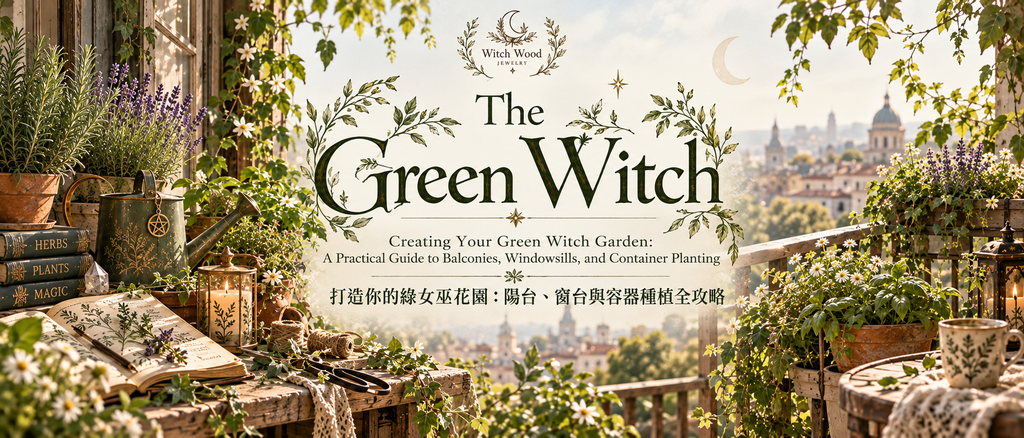
For many people, the image of “having a garden” is a plot of land with a fence, a few neat rows of vegetables, and a gravel path. But for those living in apartments, with only a small balcony or a single south-facing window, that picture feels impossible.
Yet the essence of a garden has never been about square footage. It is a space where you and plants live together—whether that space is a one-square-meter balcony, a planter box hanging on a railing, or three terracotta pots lined up on a kitchen windowsill. As long as you sow, water, observe, and harvest there, it is already a garden.
This article gathers practical methods for the urban green witch to grow herbs and medicinal plants in limited space. No yard required, no professional skills needed—just a bit of patience and a few basic judgments.
Answer a Few Questions Before You Start
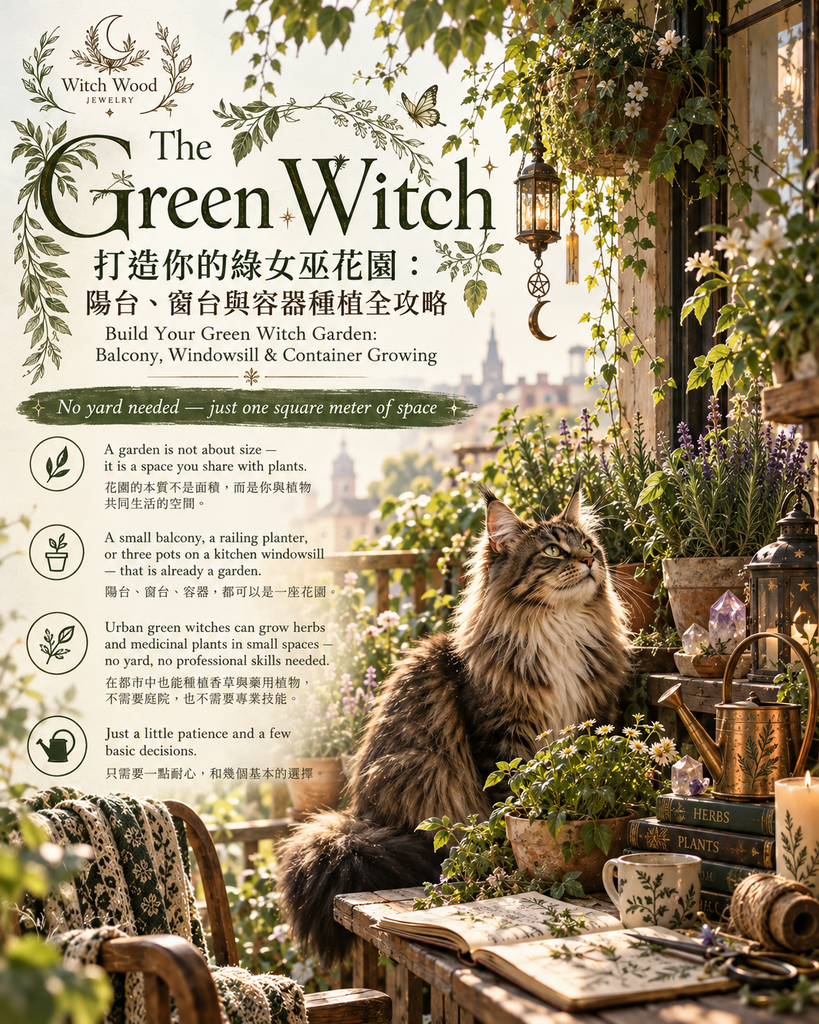
Before buying any seeds or pots, there are a few questions worth thinking through. They determine what you can grow, how to grow it, and how long you can keep it going.
How many hours of sunlight does this space receive each day? This is the most critical question. Most herbs and medicinal plants need at least four to six hours of direct light. A south-facing balcony or window gets the most sun. An east-facing one gets only morning light. A west-facing one gets strong afternoon sun. A north-facing one usually gets only indirect light, suitable for shade-tolerant plants. Observe for a few days. Note when the light starts and when it ends. Then decide what to plant.
When do you plan to use this space? If it is mainly for sitting there after work in the evening, choose plants that bloom in the evening or release fragrance at night, such as night-blooming jasmine, jasmine, or evening primrose. If you are home more during the day, choose sun-loving flowering plants.
How much time can you invest each week? Some plants need almost no care. Rosemary, thyme, and sage are drought-tolerant, tolerate poor soil, and will not die if you forget to water them occasionally. Others need daily attention. Mint, basil, and cilantro will wilt quickly if they dry out. Honestly assessing your time and energy is more important than choosing a bunch of “beautiful-looking plants.”
What are you growing these for? Is it to pick a few leaves while cooking? To make teas and herbal preparations? To add more green and fragrance to your space? Or to have a quiet corner to sit in? Different purposes lead to different plant choices and layouts.
Basic Rules of Container Gardening
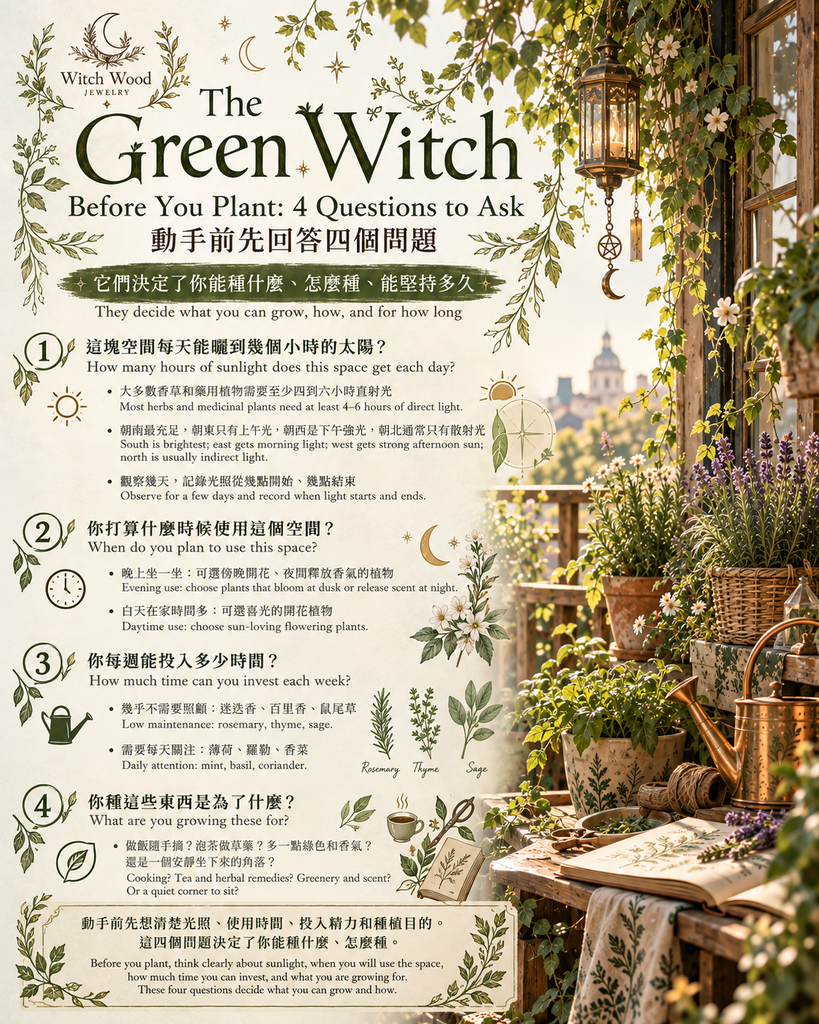
The biggest difference between container gardening and growing in the ground is this: limited root space, limited soil, and limited buffering capacity for water and nutrients. This means several things.
Containers need to be large enough. Many people like to buy small, cute pots, but plants quickly become root-bound and stop growing. Generally speaking, a single herb needs a container at least twenty centimeters in diameter and twenty centimeters deep. If you want multiple plants in one pot, the container needs to be larger, and you need to check whether their habits are compatible. Rosemary and mint in the same pot is a disaster—the former likes dry conditions, the latter likes moisture.
Drainage must be proper. Containers need holes at the bottom. Laying a layer of stones is not enough on its own. A pot without drainage holes will keep roots sitting in water, eventually causing root rot. If you like a pot that has no holes, use it as a decorative outer pot and place a plastic pot with holes inside it.
Use the right soil. Do not dig up garden soil and use it directly. Garden soil compacts in containers and has poor drainage and aeration. Use a dedicated potting mix, or make your own: peat moss, perlite, and compost in roughly equal proportions. This kind of mix is loose, drains well, and still holds some moisture.
Watering needs a rhythm. Soil in containers dries out much faster than soil in the ground, especially in terracotta pots, where moisture evaporates through the walls. Generally, you may need to water daily in summer, every two or three days in spring and autumn, and much less in winter. The test is simple: stick your finger two centimeters into the soil. If it feels dry, water. If it still feels moist, wait. Do not water on a fixed schedule. Water based on the condition of the soil.
Fertilize regularly but not excessively. Nutrients in containers get used up by plants and washed away by watering. You can apply a diluted liquid fertilizer every two to four weeks, or mix in a slow-release fertilizer when repotting. But note that over-fertilizing herbs reduces their aromatic intensity. It is better to under-fertilize than over-fertilize.
Plants Suited to Balconies and Windowsills
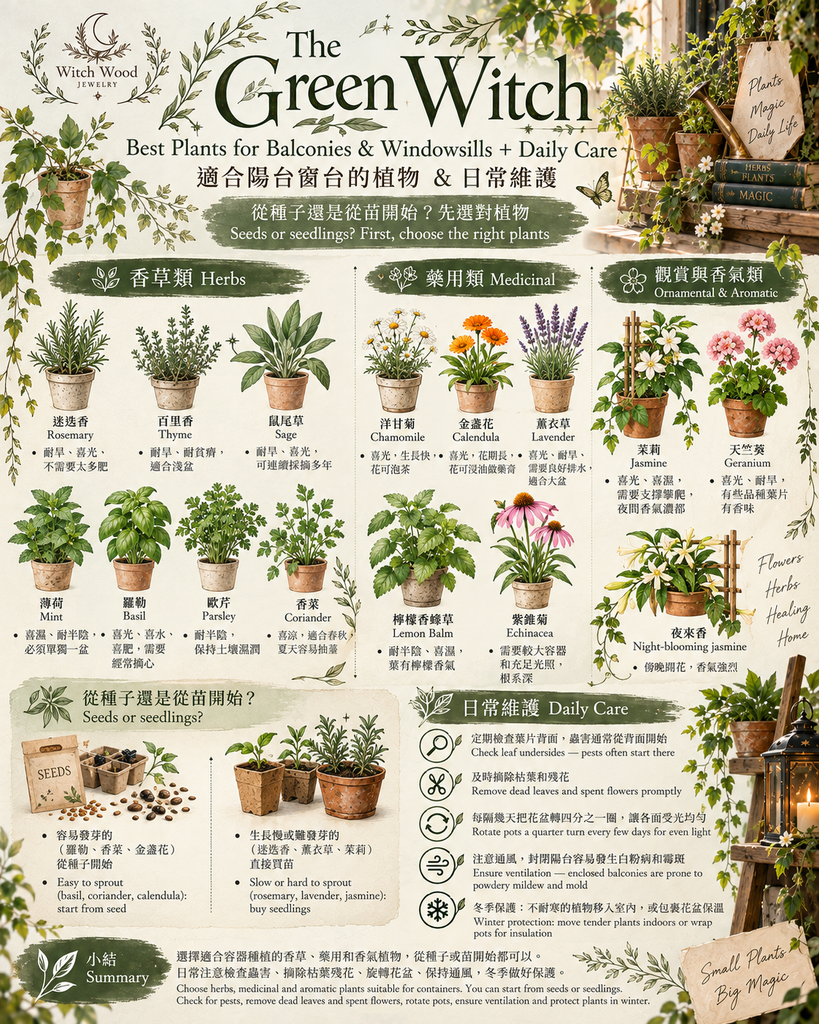
Not all plants do well in containers. The following have been tested and perform well in limited spaces.
Herbs:
- Rosemary: drought-tolerant, sun-loving, needs little fertilizer. Suitable for a south-facing spot. Can be pruned into a small shrub shape.
- Thyme: drought-tolerant, tolerates poor soil, grows low and spreading. Suitable for shallow pots. Many varieties, including lemon and common.
- Sage: drought-tolerant, sun-loving, with thick leaves. Can be harvested continuously for years.
- Mint: moisture-loving, tolerates partial shade, but highly invasive. Must be in its own pot, or it will crowd out other plants.
- Basil: sun-loving, water-loving, fertilizer-loving, fast-growing. Suitable for summer. Needs frequent pinching, or it will flower and stop producing leaves.
- Parsley: tolerates partial shade. Suitable for east- or west-facing spots. Keep soil moist.
- Cilantro: prefers cool weather. Suitable for spring and autumn. Bolts easily in summer. Sow in batches.
Medicinal Plants:
- Chamomile: sun-loving, fast-growing. Suitable for spring sowing. Flowers can be used for tea.
- Calendula: sun-loving, long blooming period. Flowers can be infused in oil or made into salves.
- Lavender: sun-loving, drought-tolerant, needs good drainage. Suitable for larger pots because roots go deep.
- Lemon balm: tolerates partial shade, moisture-loving. Leaves have a lemon scent. Suitable for tea.
- Echinacea: needs a larger container and full sun. Roots go deep. Suitable for patient growers.
Ornamental and Fragrant Plants:
- Jasmine: sun-loving, moisture-loving, needs support for climbing. Strong fragrance at night.
- Geranium: sun-loving, drought-tolerant. Many varieties, some with scented leaves.
- Evening primrose: blooms in the evening, strong fragrance. Suitable for spaces used at night.
Start from Seed or from Seedlings?
Both have advantages and disadvantages.
Starting from seed has the benefits of low cost, wide variety selection, and full participation in the plant’s journey from germination to maturity. But the downsides are uncertain germination rates, delicate management during the seedling stage, and a long growing period. Suitable for patient people willing to learn.
Starting from seedlings has the benefits of high success rate, quick results, and the ability to choose healthy plants directly. The downside is higher cost and limited variety depending on local nurseries. Suitable for beginners or those who want to establish a garden quickly.
A middle path: start easy-to-germinate plants from seed (such as basil, cilantro, and calendula). Buy seedlings for slow-growing or difficult-to-germinate plants (such as rosemary, lavender, and jasmine).
Several Approaches to Layout
Use vertical space. Balcony floor area is small, but walls and railings can hold planter boxes, hanging bags, and trellises. Climbing plants like jasmine and clematis can grow upward, saving ground space.
Layer your placement. Put tall plants in the back or against the wall, short ones in front. Put sun-loving plants on the outer layer, shade-tolerant ones on the inner layer. This way every pot gets suitable light.
Divide by function. If space allows, create a “cooking zone” (basil, mint, parsley, cilantro) and a “medicinal zone” (chamomile, calendula, lavender, lemon balm). Easy to access and easy to manage separately.
Leave a seat. If space permits, place a chair or a small stool. A garden is not just for growing things. It is also for sitting. Sitting among the plants you have grown, smelling their fragrance—this itself is one of the most important functions of the space.
A Few Key Points for Daily Maintenance
Check the undersides of leaves regularly. Pest problems usually start there. Aphids can be washed off with water or sprayed with diluted soapy water. Spider mites reproduce quickly in dry conditions. Regular misting of the leaves can help prevent them.
Remove dead leaves and spent flowers promptly. Dead leaves breed disease. Spent flowers consume nutrients. Removing them allows the plant to direct energy toward growth.
Rotate your pots. Plants lean toward the light. Turn each pot a quarter turn every few days so all sides receive even light, and the plant will not grow crooked.
Pay attention to ventilation. If the balcony is enclosed, poor air circulation can lead to powdery mildew and mold. Open windows daily, or use a small fan to promote air movement.
Winter protection. If you live in a region with cold winters, tender plants need to be moved indoors or their pots wrapped in insulating material. Some perennials go dormant. The above-ground parts wither, but the roots are still alive and will sprout again in spring. Do not throw them away just because you see them wither.
In Closing
The charm of container gardening lies in its limitations. You cannot plant everything you want, so you must choose, must let go of some things. This process of choosing is itself a way of building a relationship with plants: you learn their habits, judge whether they suit your space and rhythm, and then create the right conditions for them.
A balcony garden does not need to be perfect. There will be plants that die, sowings that fail, days when you forget to water. But as long as you are still planting, still observing, still adjusting, it is growing—along with the person tending it.
References
- Murphy-Hiscock, A. (2006). The way of the green witch: Rituals, spells, and practices to bring you back to nature. Provenance Press.
- Cunningham, S. (2000). Cunningham’s encyclopedia of magical herbs (2nd ed.). Llewellyn Publications.
- Green, M. (2002). Wild witchcraft: A guide to natural, herbal and earth magic. Thorsons.
- Beyerl, P. (1998). A compendium of herbal magick. Phoenix Publishing.
- Cowan, E. (1995). Plant spirit medicine. Swan, Raven & Company.

