
1. Card XVIII: The Moon
- Core Themes: Illusion, dreams, crisis, emotional turmoil, subconscious fears.
- Symbols & Correspondences: Pisces, Water element; Hebrew letter Qoph (back of the head, meaning hidden problems). Key symbols include: two towers (gates of Hades, boundary between unconscious and conscious self), the wolf and dog (tamed and wild self, fear of the unknown), the crayfish (primal self struggling to surface), the sun-moon (the moon dominates the sleeping sun, subconscious overshadows consciousness), golden droplets (15 droplets in the shape of the Hebrew letter for fire, “the dew of thought”).
- Upright Meaning: Traditional meaning is a crisis of faith and a period of emotional vulnerability. You cannot be sure if what you are seeing is the truth. This is a time of deep emotional conflict, and the struggle is private rather than shared. You have a decision to make; rely on your senses rather than logic. Pay attention to intuitive messages and dreams. The Moon may ask you to take a risk and broaden your life experience. You may feel disillusioned about your living situation or experience confusion and disappointment in relationships.
- Reversed Meaning: You may avoid difficult emotions and confrontations, so your needs are not expressed or recognized. A trauma is ignored again rather than explored. You may go back to old ways of coping with the past or feel stuck in an old emotional pattern that keeps arising until you give it attention.
- Wisdom Message: “Be guided by messages from your unconscious.”

The Moon Spread (What Lies Beneath) : Place The Moon card, draw 4 cards. Ask: “What needs to come to the surface?” or “What will be the outcome of this crisis/soul-searching?” (Positions: 1 Significator—a card that represents you, 2 What needs to be addressed—past or childhood issues, 3 What needs to be addressed—present challenges or fears, 4 Outcome)

2. Card XIX: The Sun
- Core Themes: Success, good health, happiness, holiday, positive energy.
- Symbols & Correspondences: The Sun, Fire element; Hebrew letter Resh (front of the head/face, meaning success). Key symbols include: the sun (21 rays, reducing to III The Empress; symbol of consciousness, happiness, and self-expression), the child (simplicity, innocence, purity, and the happy inner child), sunflowers (growth, beauty, and strength; four sunflowers symbolize the four elements), walled garden (boundaries, security, and protection), white-gray horse (the vehicle for the soul—the physical body), red flag (energy and vitality), red feather (life force).
- Upright Meaning: Brings success and achievement and is one of the most positive cards in the major arcana. If you have had a challenging time, the Sun shows that every aspect of your life will improve. You will enjoy more energy, and if you or someone close has suffered from health problems, the card predicts recovery. All your projects benefit now, making it a good time to nurture creative endeavors, business, and valued relationships. Associated with children and family, happy times with friends, and reunions with old friends. In a layout with “negative” cards, the Sun has the power to shed a positive light on the whole reading.
- Reversed Meaning: It is virtually impossible to see any negative side to the Sun, even when reversed. The only possible glitch could be a delay to travel plans, but you will enjoy a happy and content period regardless.
- Wisdom Message: “Enjoy your success.”

The sun :This is a simple four-card spread based on the four elements theory. The four cards answer questions about four aspects of life: material foundation (Earth), action and decision-making (Air), career development and communication (Fire), and emotional flow (Water). The Sun card serves as the guide of the spread, symbolizing positive energy, success, and clarity, bringing a positive light to the entire reading.

3. Card XX: Judgment
- Core Themes: Assessment, letting go of the past, spiritual awakening, rebirth, self-reflection.
- Symbols & Correspondences: Pluto, Fire element; Hebrew letter Shin (tooth, meaning renewal). Key symbols include: Archangel Gabriel (blowing the trumpet, awakening us to examine the past), the trumpet (calling to resurrect the past and make a decision), the dead rising from coffins (resurrection and rebirth; six naked figures representing different phases of the past), the flag of St. George (red and white symbolizing the unification of opposites), the sea and glaciers (purification; the past can be forgiven and washed away).
- Upright Meaning: It is time to come to a decision about the past. Great changes and opportunities are on the horizon, but before you can decide on your direction, certain past issues need to be addressed. This process is purely about how you judge yourself on your past actions and attitudes. In the upright position, Judgment shows you will feel you have acted with integrity and did the best you could. As you accept yourself fully, you can blow your own trumpet and praise yourself for your achievements. An additional meaning is being in the public eye—hence Fame, the card’s alternative title. Judgment also predicts a spiritual awakening, as you feel called to explore your potential.
- Reversed Meaning: You may be stuck in the past or refuse to learn the lessons that are there for you. You may find yourself in old patterns and not yet able to break free. Delays are indicated for future plans, and you may feel trapped and unable to progress without really understanding why. You have the ability to judge your actions and attitudes and then move on; the past cannot be changed, only accepted. Have compassion for the person you were then and for the decisions you made. You can decide to be free.
- Wisdom Message: “Look back with pleasure.”
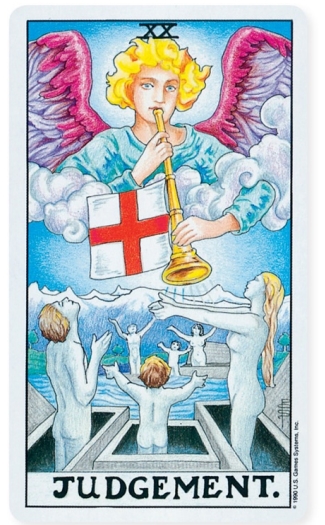
Judgment Spread (The Spiritual Audit) : Place Judgment card, draw 5 cards. Ask: “How do I judge myself?” or “What past situation can I let go of?” (Positions: 1 Present situation, 2 The recent past—what to look at and let go of, 3 The distant past—what to look at and let go of, 4 What may be blocking you, 5 Outcome—what you can learn from this)

References
Greer, M. K. (2019). Tarot for your self: A workbook for personal transformation (3rd ed.). Weiser Books.

